
GTB’s Novels
GTB wrote twenty-three novels between 1943 and 1999.

A novel difficult to categorise within any of the realist currents of the 1940s, not only due to its theme and setting, but above all because of its protagonist’s personality. Javier Mariño is a young Spaniard whose life constitutes a continuous confrontation between three problems: his religious morality, his conception of love, and an acquired political ideology. The structural linearity and the mixture of expressive levels are formal defects attributable to any first narrative. The content, distorted by the modification of the ending—a consequence of problems with censorship—acquires an ideological sense that the plot did not need at all. (Carmen Becerra, «Annotated Bibliography», in Los Mundos de Gonzalo Torrente Ballester, 2010, vol. II, p. 233 et seq. Hereafter, CB).
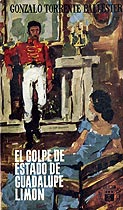
The theme of myth re-emerges: its origin, development, and falsehood. Plot-wise, it tells a story of love and intrigue in which a personal and amorous rivalry develops between two women, a rivalry that will lead to incredible consequences. The coup d’état is a historical fiction that needs to be retold to give way to the truth. Thus, two aspects of Torrente’s literature are revealed: his taste for history and his tendency towards demythification. CB.
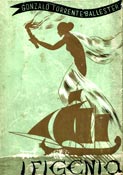
It entails the recreation of a classical myth through the subversion of all typified values by attributing to it a series of traits that can become opposite to traditional ones. This short novel could signify the scepticism its author had reached regarding political ideologies. CB.
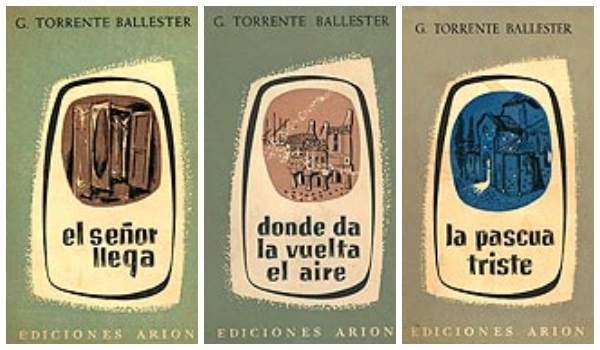
The trilogy Los gozos y las sombras, probably the work that has given its author the most popularity, unfolds almost entirely in Galicia: land and people that, by birth, experience, and reflection, he knows perfectly. Born when social realism reigned in Spanish literature, it escapes this current by not using novelistic materials from the surrounding reality to transform that reality, but to analyse it in depth and probe its deepest causes. In the Carlos Deza-Clara Aldán relationship, the concept of love we discovered in Tobías reappears. Exquisite treatment of female psychology. In this trilogy, Torrente also provides us with his particular vision of the theme of the ‘pazo’ (manor house) in a specific era. A theme also used by other Galician authors, such as Elena Quiroga, Pardo Bazán, or Valle-Inclán, although addressing another moment in the process and from another perspective. CB.
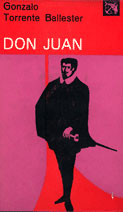
Highly original version of our most universal literary myth. The audacious Sevillian seducer strolls through 1960s Paris, using, for his amorous conquests, subtler and more harmonious methods to which he has been naturally driven by the limitations imposed by age. Among other things of similar importance, Torrente provides a theological explanation here for Don Juan’s Don Juanism. In many of its pages, the playful facet that will reach its peak in La saga/fuga de J. B. is announced. The structure, which undoubtedly refers back to Cervantes, is more experimental and complex than in previous narratives. CB.

Gallery of marginal characters without connection to each other, but all related through the link each group establishes with one of the novel’s protagonists. It uses the technique of objectivism, highlighting its limitations for achieving a deep knowledge of the human soul because, Torrente Ballester asserts, man is an animal that lies. CB.

First work of the so-called “Fantastic Trilogy” by sectors of the critics. A novel of enormous structural complexity and difficult to read if one aims to discover all its meaningful levels. Its protagonist, J. B., represents, in the Galician world, the myth of Sebastianism, a Celtic myth of redemption. Only language sustains the fantastic narrative world created, becoming its main foundation; hence almost all the resources used are based on linguistic play. The problem of the diversity of the self reaches enormous development here. Torrente Ballester masterfully deploys the entirety of narrative systems: discourse, interior monologue, letters, third-person narration, journalistic chronicle… The materials used are as diverse as the resources: from real characters to literary or invented ones, from mockery of structuralism to the use of legends that are versions of other well-known ones, from the wizard Merlin to the Knights of the Round Table, from Bello’s grammar to the levitation of an entire city… Culture, fantasy, and mastery of the art have produced this fascinating novel in which humour and irony reach their highest peaks. CB.

Second work of the so-called “Fantastic Trilogy”. From the subtitle, we know the story being told: how a novel is made. The narration contains three planes: the realistic story, the fantastic narration, and the critical reflection. Interferences between the planes produce a de-realisation of the real and ambiguity, a resource much used by the novelist. Once again, the presence of cultural materials is important. CB.
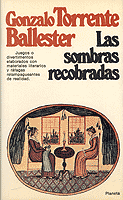
A book of stories, some rewritten –El cuento de Sirena, Farruco el desventurado– and others newly created –Farruquiño, Mi reino por un caballo, El hostal de los dioses amables–, but all with the common thread of stemming from family stories, from memories. El cuento de Sirena collects the legend of one of the Mariños, saved by the Siren from certain death, who returns him to land on the condition that one day she will come to fetch one of the Mariños and take him with her to the depths. Farruco el desventurado and Farruquiño both stem from the same seed: the author’s childhood world.

Final work of the so-called “fantastic trilogy”. “Love letter with magical interpolations” is the subtitle that corresponds to the narration, from the present, of a failed seduction process (love letter) and the resources used in that process (interpolations). In parallel, the realistic story is used in one case, and the fantastic story in the other, clearly distinguishing between the two planes. However, interferences, as in previous novels, also occur here. The rhythm of the two planes is different, with that of the fantastic plane being dependent on the rhythm of the real plane. It is interesting to note that, for various reasons, it is the character of Napoleon who sustains both planes. CB.

A novel in which the mixture of lived reality (the author’s childhood world) and dreamt history (the story of Dafne) does not only obey mere formal design –even-numbered chapters for one, odd-numbered for the other– but to an authentic fusion of both worlds; so that while the fantastic becomes real, the real acquires the category of dream and mystery. CB.

Novel written between the years 1950-1951. In this edition, no corrections are made beyond mere detail, respecting Torrente’s style of that era, a fact that reveals to us that its author was not born spontaneously with La saga/fuga de J. B. The starting point is the tale of Sleeping Beauty; Torrente awakens her in the 20th century and subjects her to a process of education and updating, making several centuries of History pass before her in a few days. For the analysis of this novel and the trajectory of its author, it is important to consider the pessimism of the denouement. CB.

Using the techniques of the detective novel, it elaborates a worked-out plot in which we discover, through a new and original approach to the multiplicity of the self (a being who only exists through others), themes already common in Gonzalo Torrente’s fiction: love, freedom, falsehood and the manipulation of history, contemporary myths…. CB.

A wide range of literary styles, in accordance with the diversity of narrators, compose this story, whose place, time and some of its characters are versions of other historical ones that are recreated, invented, or modified. Epistolary technique and multi-perspectivism. CB.

Parody of the multiplicity of the self inspired by the problem of Fernando Pessoa’s heteronyms. It is structured in two planes, that of reality and that of fiction, with the latter being the engine of the former; that is, the action of the reality plane advances along the thread of the data we discover in the fiction plane. The chapters Gamma, Zeta, and Sigma –fiction plane– contain the search for the voice, the creation of space, and the invention of characters, respectively. Among the various styles that, due to content, the novel requires, those of Uxío Preto and Ana María Magdalena stand out, a voice through which we note the author’s profound knowledge of certain female types. CB.
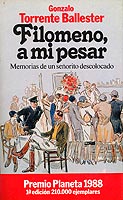
With this novel, written in the form of memoirs (“Memoirs of a Displaced Young Gentleman”), Torrente surprises us by abandoning the mythical-fantastical world in which he had installed us for over a decade, and immersing himself again in realistic fiction. The novel is characterised by having an entertaining plot and an evident technical simplicity: clear ordering of events that unfold with an almost total temporal linearity, through a single and unmistakable narrative voice. The recipe is simple: combination of the vital flow of a character with a very broad and well-known historical backdrop. We highlight, for its aesthetic quality and for the presence of humour, a capital trait in Torrente’s work, the sixth and final chapter. CB.

The action, set in the 18th century, revolves around the king’s wish to see his wife naked and the commotion this desire provokes in the Court of Madrid, among his subjects and the clergy. The scarcity of historical data, dates, and proper names responds to the intention of not pigeonholing the novel precisely into the formula in which criticism, in general, has placed it, the historical novel. A most amusing tale where sex and sin, so intimately united in traditional Catholic thought, become the object of parody in this novel. As in many of his other creations, we notice several levels of reading: from superficial entertainment to the critical analysis of certain social situations. CB.
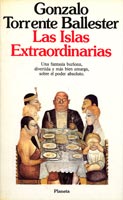
A novel of fantastic and detective appearance that contains, despite its brevity, an interesting ideological complexity due to the presence of themes, discourses, and counter-discourses proceeding from a cultural baggage that the author uses and transforms. It addresses the final treatment of power, a theme much frequented by the author, its essence, and the consequences entailed by its exercise. CB.
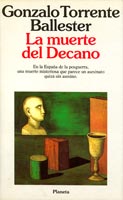
New example of the use of so-called popular genres: a detective or crime novel, set in a university environment, investigating the cause and perpetrator of the dean’s unexpected death. The discovery of the enigma is intimately related to the different conceptions of History held by the characters. CB.

A narrative of a metafictional nature in which the reader faces a fragmented text with a changing narrative consciousness among the various characters, who hold divergent opinions about the novel Pepe Ansúrez intends to write. With this technique, the author offers a satirical picture in which he sketches the life of some vulgar characters, immersed in petty intrigues and everyday miseries, and upon whom he casts a gaze both grotesque and tender. CB.

A novel with which Gonzalo Torrente shows his knowledge of the social life and customs of a provincial town. Set in the immediate post-war period in Spain, the Recalde sisters, but fundamentally Chon, fight for their personal dignity by upholding their principles, against a rigid caste society where hypocrisy is the most evident value. The vision of women in this type of society is notable. CB.
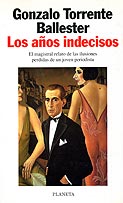
Excellent example of the autofictional novel, a formula much used by contemporary narrators, which allows the author a new inquiry into identity. The action, which takes place in the years immediately following the Second Republic, reflects the uncertainty of a young man, nameless, whose future is undecided and who only reaps doubts and failures. CB.
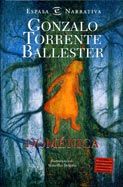
Published after his death, it is the author’s only foray into children’s and young adult literature. In this tale, Gonzalo Torrente narrates a delightful and fabulous adventure, deploying all his gifts for imagination and fantasy. This first edition is beautifully illustrated by Maravillas Delgado. CB.