The Foundation
Gonzalo Torrente Ballester Foundation
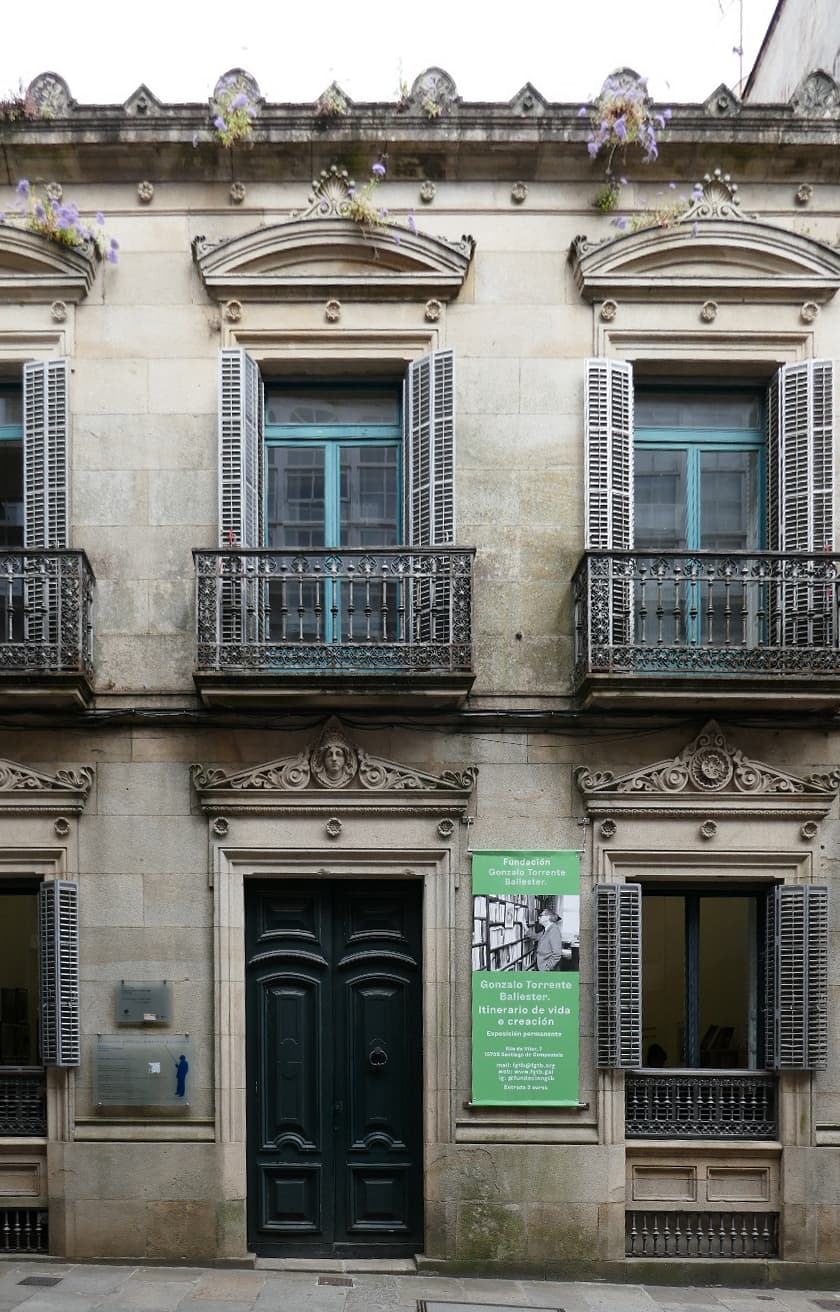
The Gonzalo Torrente Ballester Foundation (FGTB) was established in Santiago de Compostela on 22 July 1999. Its founding institutions are: the Galician Regional Government (Xunta de Galicia), the Santiago de Compostela City Council, the A Coruña Provincial Council and the University of Santiago de Compostela. It is defined as an entity “of Galician interest, of a cultural, private, permanent and non-profit nature”.
The FGTB safeguards the legacy of its founder by housing the entirety of his library and personal archive consisting of articles, letters, personal belongings, paintings and awards, as well as hundreds of reels and magnetic tapes with his voice.
Since its beginnings, the FGTB headquarters became an important reference point for cultural activity in Santiago de Compostela, becoming a meeting place for artists, writers, researchers and people related to the world of science and culture at congresses, seminars, conferences, exhibitions, round tables and screenings, which contribute to the dissemination of literature, art, theatre, film or photography.
Aims
The aims of the Foundation are summarised in promoting the study of Gonzalo Torrente Ballester’s work and the conservation of his cultural legacy, and are specified as follows:
- To promote research and study of the figure and work of Gonzalo Torrente Ballester.
- To contribute to the location and recovery of all the author’s production, both professional or public and private or personal.
- To bring together his bibliographic and documentary heritage (manuscripts, photographs, etc.). In short, the assets that make up his personal archive in order to guarantee their permanence in time and space.
- To contribute to and participate in the human, cultural, social and scientific development of Galicia in particular and Spain in general.
GTB Research Centre
Library

The library of the Gonzalo Torrente Ballester Foundation safeguards the legacy of its founder, who donated to the institution all his books from his homes in Salamanca and A Ramallosa (Pontevedra). Each and every one of the copies that make up his personal library, stamped with his ex libris, are of incalculable value as they constitute the reading universe in which Gonzalo Torrente lived, in which he trained to develop his professional facets as a writer, critic and teacher and his diverse and varied hobbies and interests (music, art, theology…). But also, the library treasures particularly valuable copies because they contain personal dedications, annotations by Torrente Ballester himself or because of their age or rarity.
The collection consists of around 14,000 books organised using the UDC (Universal Decimal Classification). The library is part of the Galician Library Network and its catalogue can be consulted online.
In this bibliographic collection, which occupies the second floor of the building, we can distinguish five main sections:
- Areas of knowledge on which GTB read and studied: philosophy, theology, language and linguistics, architecture, painting, photography, music, history, from whose variety and volume can be inferred the unlimited interest in art of the prolific and multifaceted author.
- Literature, literary theory and criticism, the largest section given his profession as a writer and teacher of literature and grammar, the latter profession which he practised for forty years and which he championed above any other of his professions.
- Periodicals, a section consisting of single issues of publications containing articles by and about GTB and others to which he subscribed or purchased regularly, among which we find both literary and cultural magazines (Cuadernos hispanoamericanos, Nós, Escorial, Cruz y raya, Boletín de la RAE, Revista de occidente, Grial) as well as publications of the most diverse nature (Paris Match, Revista de arqueología, Concilium. Revista internacional de teología, National Geographic, Gaceta ilustrada).
- GTB’s works. In a place separate from the rest of the collection, almost all of the published editions are located, as well as the translations and his contributions to collective volumes with articles, conferences, etc., or by other authors with prologues and introductions. The library also has a section dedicated to studies on GTB. This is the only open section, which is constantly updated with the latest publications and research papers (theses, dissertations).
- Historical collection. Considering as such those copies published before 1900, the collection is completed with some 250 volumes. The oldest copy, on a religious theme, dates from 1669.
On the first floor of the headquarters (the reading room) is the FGTB collection consisting of all those books that did not belong to GTB’s personal library: publications related to the cultural activities carried out at the institution (exhibitions, conferences, etc.). Also donations, notably the one received, from New York, from the American professor Drosula Lytra to the FGTB of approximately one thousand volumes, mostly Spanish literature.
Archive
It consists of twelve inventoried sections in the process of description and digitisation:
Originals
Consists of 29 boxes and 165 files. This is one of the most valuable series as it contains handwritten and typewritten originals, corrected proofs, different versions of the same work, notes, annotations, prologues, lectures, articles, etc.
Adaptations of some of GTB’s works
This series consists of 6 boxes and 47 files and contains scripts and adaptation projects of different works by GTB, some of which were carried out (Los gozos y las sombras, El rey pasmado) and others not (Campana y piedra, El golpe de Estado de Guadalupe Limón, Off-side, among others).
Press
25 boxes contain, classified in 71 files, the articles written by GTB in the press, others published about him and his work (interviews, reviews) and some on diverse topics that interested the writer at the time.
Papers, theses and publications on GTB’s work
15 boxes and 85 files.
Works sent to GTB for his review
These 17 boxes with their 128 files contain works of various kinds (literary, research, translations…).
Correspondence
GTB’s correspondence occupies 13 boxes with a total of 3745 items.
Photographs
11 boxes contain albums, photographs, negatives and slides from the personal and professional sphere of GTB’s life.
Music
19 boxes contain 329 records of different musical genres, owned by GTB.
Tapes and cartridges
Undoubtedly, the most unique and valuable section of the archive, containing a total of 407 items, some of them music but mostly recordings that GTB made with his tape recorders and recorders. In the process of digitisation, transcription and ordering, the recordings are classified into: interviews, work notes, lectures, classes and personal diaries.
Personal file
1 box
Honours and awards
Consists of 7 boxes with 111 items, some of which are exhibited at the foundation’s headquarters.
Miscellaneous
Consists of 6 boxes containing all kinds of documentation contained in GTB’s library books.
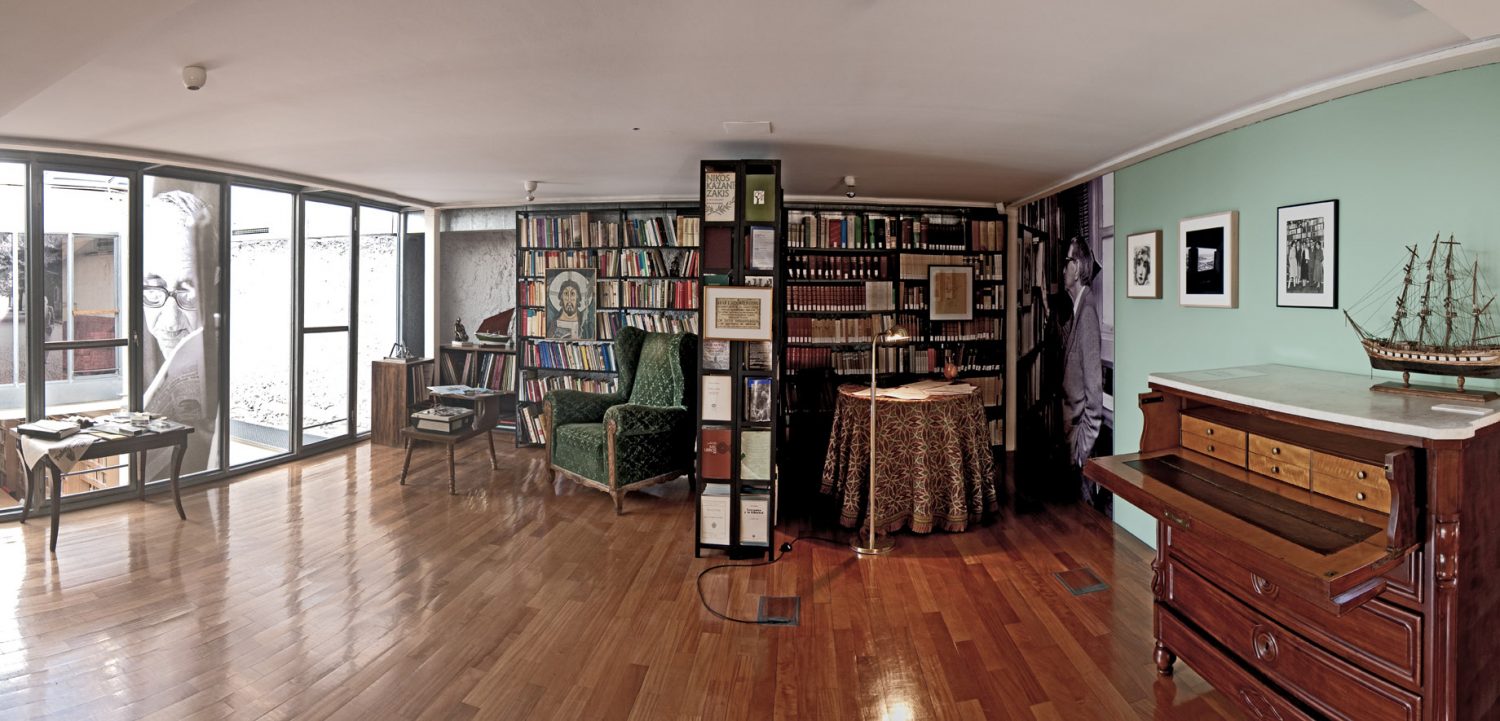
The writer’s corner
One of the constants in Torrente’s life has been to inhabit a pleasant, harmonious space that allows him to isolate himself when his ghosts so demand.
(Francisco Castaño, 1996)